That wince when they slip — you feel it too, don’t you?

How Owners Of Older Dogs Are Making Their Floors Safe Again. Small Changes Go A Long Way.

Haven’t you noticed their steps getting slower over the years? They’re being extra careful too. Let’s help them out a bit.

A woman in her late sixties watches from a doorway as her old golden retriever crosses the bare hardwood between a hall runner and a rug
The hallway: every dog’s fastest lane, and a fragile joint’s worst enemy. This is where it happens.

You’ve learned to be careful. A hand on the rail. A slower step on wet tiles. Nobody had to explain a fall to you; you understood it the first time your own knee complained on the stairs.

They haven’t learned any of that. How to slow down. How to notice it isn’t the same as it was. She’s twelve — in her years, older than you — and she still takes the corner into the hall at full speed at any noise from the door. You hear the claws, you hear the scramble, and you hold your breath, willing her not to come flying out and down the stairs. Then she’s at your feet, delighted, and you tell yourself she’s fine.

So you did what careful people do. A runner in the hall. A rug by the bowl. The rubber rings for her nails. And still, somewhere between one rug and the next, she slips. Here’s what we’ve been telling owners for years — and why the fix is smaller than you think. Did I mention it’s actually superb for house décor? Her safety comes first, but I won’t pretend I don’t enjoy that it looks good too.

01
Reason one

She’s looking at you. Not at the floor.

Ask any owner where it happens and you’ll get the same three answers. The rush to the door when she hears you. The corner into the hallway. The turn at the bottom of the stairs. She’s looking at you, not at the floor — and on smooth boards, her back legs are doing something her front legs don’t know about.

You would never take that corner the way she does. You don’t have to — you know what a fall costs. She doesn’t, and she never will. That’s not a training problem. It’s a floor problem, and floor problems are the kind you can fix.

A dog rounding a hallway corner too fast, back legs skidding out on the polished floor, with an 'ouch' at the hip
Wrist catches the slide. Hip does the scramble. You won’t be able to tell, until they start limping.
02
Reason two

It’s not her legs that fail her. It’s the two feet between the rugs.

It’s not her legs. My baby is only twelve — I know she has years to go. She still gets up the stairs, still bolts for the door. Watch where the slip actually happens and it’s almost never on the rug. It’s the strip of bare floor between one rug and the next. A dog crossing a room hits three or four of those strips, forty times a day.

You know the feeling. You step off the footpath onto a patch of ice you didn’t see, and for half a second your foot isn’t yours. The jolt goes straight up — knee, hip, the small of your back — before you’ve even finished the thought. Your whole body clenches. Then you’re fine, and you walk the rest of the way like someone who’s been reminded.

Two panels: a woman and her dog walking happily along a snowy footpath, then the same woman slipping on a patch of ice with a 'WOAH!' while the dog looks back
Half a second. Knee, hip, back. You remember it for a week.

Now put that patch of ice in your own hallway. Cross it forty times a day. At a run. On four legs, with nothing to grab. That’s the gap. That’s what she’s doing every time she goes for a drink of water — and she doesn’t get the reminder, because she can’t slow down for a thing she can’t see.

You wouldn’t put a bath mat with a gap in the middle of it. Rugs don’t fail because they’re bad rugs. They fail because a path with gaps in it isn’t a path. Close the gaps and the slipping stops being a mystery.

Top-down view of a hallway: a jute runner, two feet of bare oak, then a rug; an old golden retriever's back paws slide on the bare strip, labelled 'the gap'
Runner. Two feet of bare floor. Rug. The gap is where the ice is.
03
Reason three

Paw-friendly routes. No need to bubble-wrap the house.

Canine Arthritis Management is a UK charity run by vets who published a home-assessment guide for owners whose dogs struggle on smooth floors. Their recommendation isn’t a new floor, and it isn’t a rug in every room. It’s a path they can follow.

So what do the vets actually recommend?Tap to reveal

Lay carpet tiles along the routes she actually walks, and on the spots where she slips.

Canine Arthritis Management, home assessment tool[1]

We recommend around the bed first, because joints and muscles are stiffest after rest. Then bed to bowl. Then the hallway to the door. A handful of routes, not a whole house. The same way you salt the front steps, not the whole street.

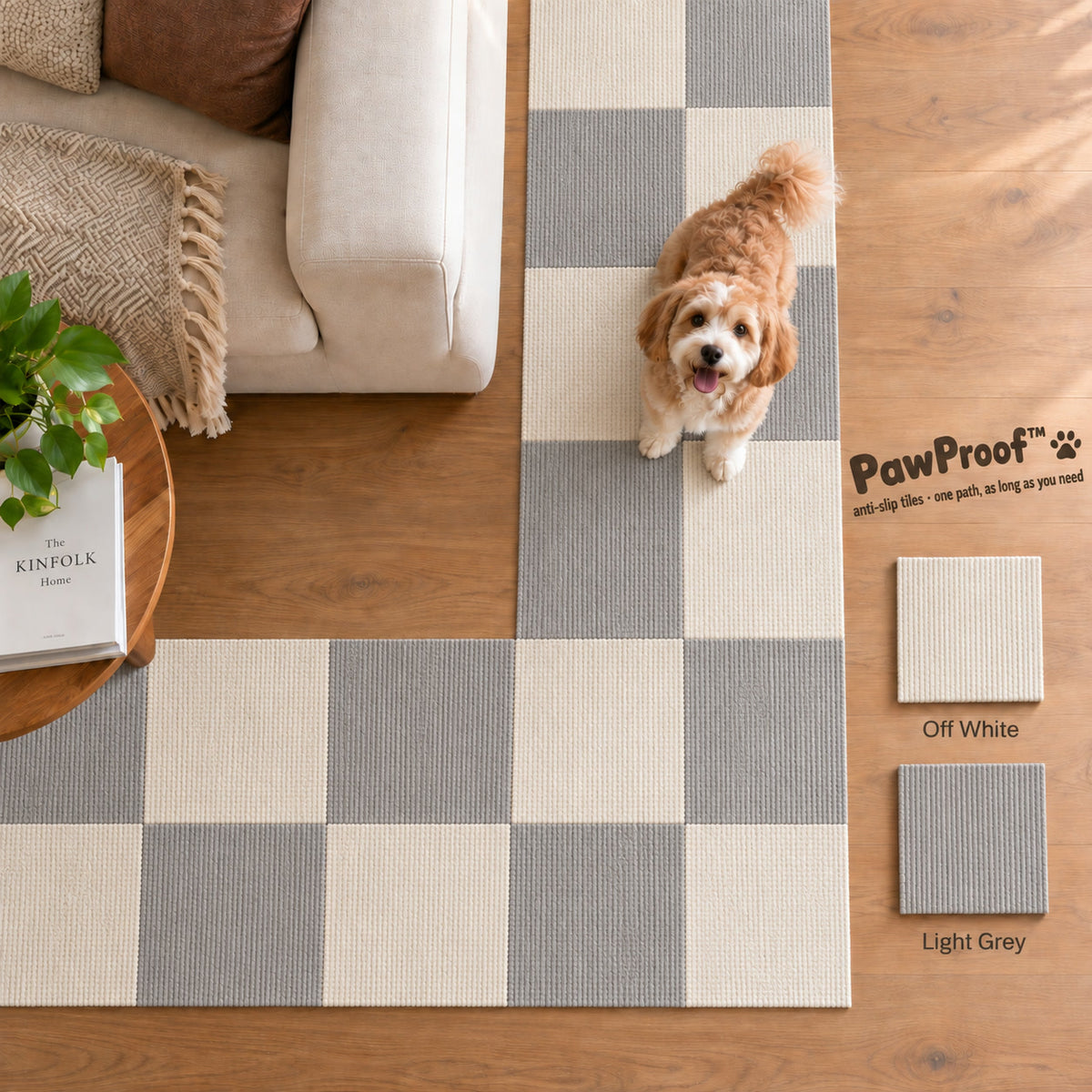
That’s the thinking behind a set of carpet squares called PawProof: build the path she already walks, square by square, with no gaps.

Floor plan of a home showing three carpet-square routes: beside the bed, bed to bowl, hallway to the door
See the PawProof path → 20 squares · bed to bowl to door · 45-day money-back guarantee
04
Reason four

Put the path where the day starts.

You know the first steps out of bed are the stiff ones. So does she. She just can’t say so. For an older dog, the first few strides after rest are the wobbliest of the day: half-awake, stiff, pushing off on a floor with nothing to push against.[1]

And here’s the difference. You get up when you’re ready. You leave the room when you’re ready. She doesn’t get that choice. She waits, ready or not, and her cue is the moment you stand up. Stiff legs, cold floor, and a person to keep up with.

Two panels: a woman sits on the edge of her bed with tea while her dog waits in its bed watching her, then she stands and the dog scrambles up after her, back legs skidding on the bare floorboards
Ready or not. Her cue is you.

You’ve made her bed lovely. Six or eight squares around it change the first thing her paws meet every morning. Most people start there and add the route to the bowl next, because once you’ve watched her get up on carpet you can’t unwatch her get up on wood.

An old golden retriever stepping out of a grey dog bed onto a path of light grey and off-white carpet squares laid across an oak bedroom floor
The first thing her paws meet.
05
Reason five

Grip belongs on the floor, not on the dog.

Most of what’s sold for slipping goes on the dog. Rubber rings on the nails. Grippy socks. Paw wax. The reviews tell the same story every time: chewed off the first night, gone in a week, forty dollars for a bag of rubber bands.[3]

Imagine a rubber band stuck to each of your toes, all day. Or think of winter: coat, beanie, gloves, scarf. You know that moment when you get inside and just need it all off? Stuffy, itchy, in the way. Grip you wear is no different. I tried the rings on my own girl once, and her face told me everything I needed to know.

Put the grip on the floor and there’s nothing on her at all. It’s there at three in the morning when she gets up for water, and it never comes off.

Split illustration: on the left, nail rings, a grip sock and paw wax scattered on hardwood beside a dog's paw with a ring slipping off; on the right, the same paw planted on a ribbed carpet square
On the dog, it comes off. On the floor, it stays.
06
Reason six

Same excitement. Better footing.

The goal was never to slow her down. She should still come flying when she hears the car. The floor is what changes, not the dog.

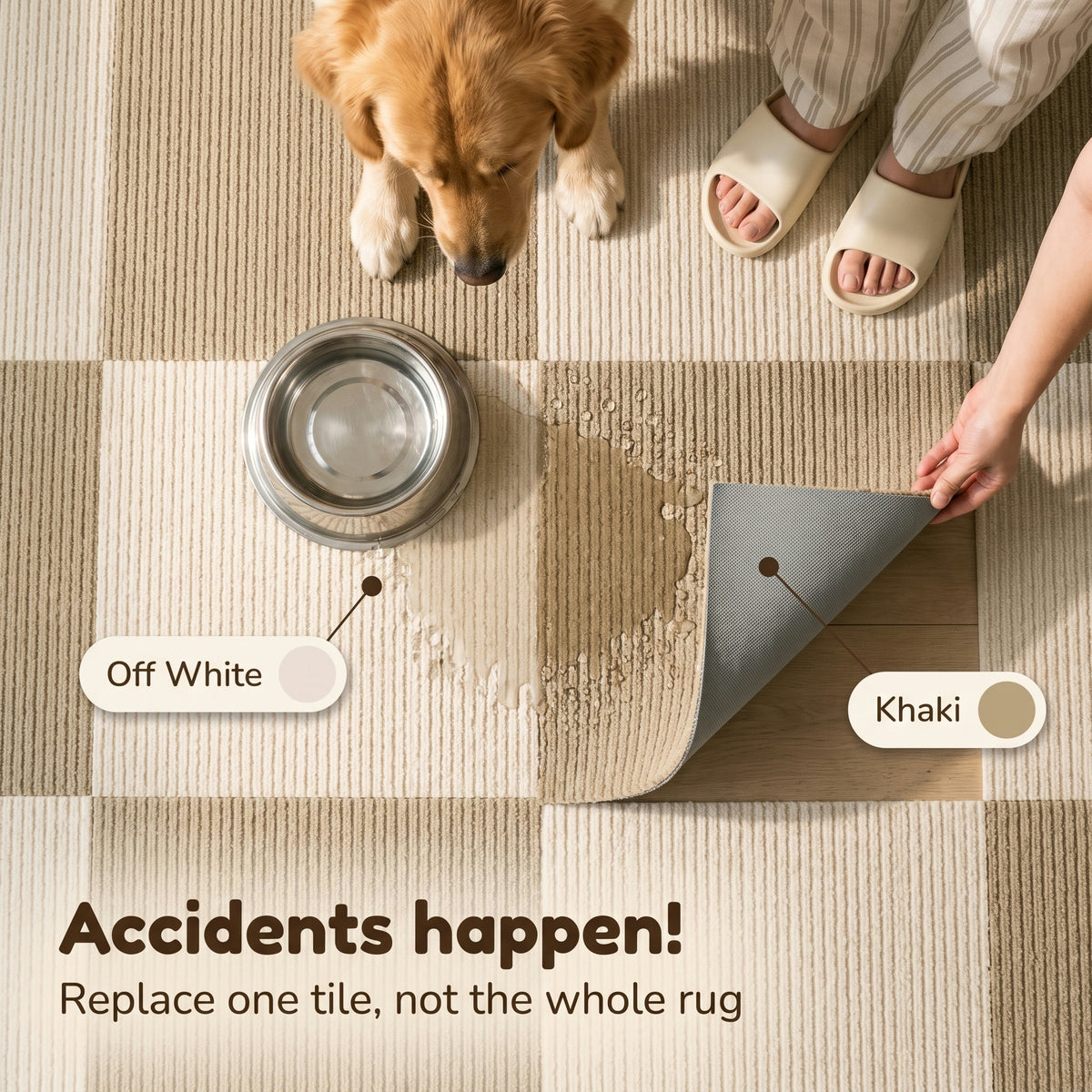
Each square has a ribbed carpet top her paws can dig into and an electrostatic backing underneath. No glue, no tape. It clings to a smooth floor the moment you press it down, holds when she pushes off, and peels up clean when you want to wash one square or move the path. Water-bowl splashes, muddy paws, the odd accident because she’s twelve: it lands on one square. Pull that one, rinse it, press it back. Nobody drags a rug to the laundromat. On sealed hardwood, test one square in a hidden corner for a few days first; every finish is a little different.

A two-wide path of light grey and off-white PawProof carpet squares laid across an oak floor beside a cream sofa, with a small dog standing on it
Laid straight onto sealed oak. Nothing under it but the backing.
See colours and sizes → 7 colours · two square sizes · free US shipping available
07
Reason seven

You learned to be careful. She can’t. So you do it for her.

They age faster than we do, and they hide it better. A dog doesn’t tell you the floor has become work. She just stops running to the door, or picks the couch because it’s easier to get up from than the tile. By the time there’s a limp, the months of scrambling are already behind her, and you can’t give those back.

You’d fix a loose step before anyone tripped on it, not after. This is the same decision, made for someone who can’t make it herself. For less than a vet visit, with 45 days on your own floors to decide whether it was worth it.

  • Day oneSome dogs walk the edge of the path first and sniff it. That’s normal. It’s new, and new is weird for them.
  • Day two or threeMost take the path without thinking about it. They’ve noticed the difference, and how easy it is.
  • After thatYou notice what you don’t hear: claws scrambling round the corner. Mind at peace. Joints safe.
One PawProof carpet square lifted from the path to be washed after an accident, the rest of the path still in place
One square out, one square back. The rest of the path never moves.

What the vets say

“Around the bed first: after rest, dogs are at their most vulnerable and stiff.”Canine Arthritis Management, home assessment tool[1]
“Dogs with osteoarthritis struggle to stabilise on vinyl, tile, or hardwood. Slip-resistant surfaces help.”Dr Joyce A. Login, DVM, Zoetis Petcare[2]
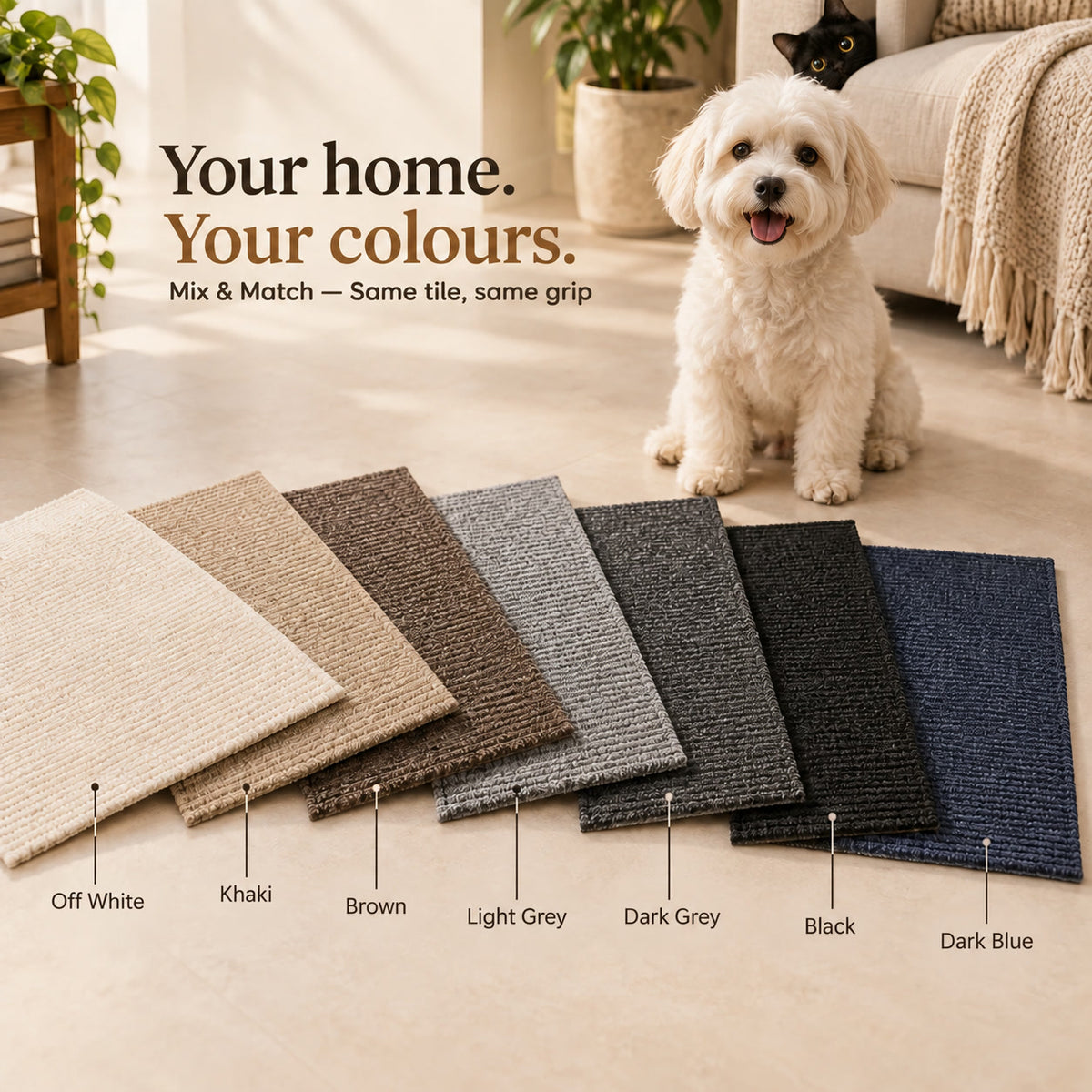
Seven PawProof carpet square colours fanned out: light grey, dark grey, dark blue, khaki, off-white, brown, black

The PawProof path

Twenty carpet squares. Bed to bowl to door.

  • Ribbed carpet top, no-glue electrostatic backing. Lifts clean.
  • Seven colours, mix or match to your floor
  • Cuts with scissors for doorways and corners
  • Wash one square. Replace one square.
  • 45-day money-back guarantee
Choose your tile size
Bundle & Save
Choose your colour

45-day money-back guarantee · Free US shipping available on bundles!

Common questions

Will it mark my hardwood?

The backing is electrostatic, not adhesive. There’s no glue to leave anything behind. It lifts clean off laminate, vinyl, LVP, sealed hardwood and smooth tile. On sealed hardwood we still say test one square in a hidden spot for a few days first, because finishes vary.

How many squares do I actually need?

Around the bed: six to ten. Bed to the bowl: about ten. Bed to bowl and the hallway to the door: twenty. Squares lay two wide as a path. Large dogs are better on the 60 cm square.

Isn’t this just carpet tiles?

It’s carpet squares, yes. That’s the point; it’s what the vets’ guidance recommends. The difference is the backing that holds under a push-off without glue, the ribbed pile a paw can dig into, and that each square lifts, washes and goes back on its own. It’s sold as a path, not as flooring.

What if she won’t walk on it?

Some dogs walk the edge for a day and sniff it. Almost all take the path by day two or three. If yours doesn’t, or it doesn’t suit your floor, send it back within 45 days for a refund.

Shipping and returns?

Tracked US shipping, free on bundles. 45-day returns. If it doesn’t suit your floor, send it back.

Sources

  1. Canine Arthritis Management (UK), Home assessment tool, flooring: “carpet tiles, off-cuts and runners along the routes or on the problem spots”; “around the bed first: after rest, dogs are at their most vulnerable and stiff.” caninearthritis.co.uk
  2. Login, J. A., DVM. Zoetis Petcare, guidance on osteoarthritis in dogs and home flooring: “Dogs with osteoarthritis struggle to stabilise on vinyl, tile, or hardwood. Slip-resistant surfaces help.” zoetispetcare.com
  3. Publicly posted owner reviews of wearable canine traction products (nail grips, traction socks, paw waxes) on major US retail sites, read September 2026. Commonly reported: pieces chewed or worn off within days; repeated repurchase. Retailers and brands are not named here.
  4. Canine Arthritis Management (UK): osteoarthritis is estimated to affect four in five dogs over the age of eight. caninearthritis.co.uk